Cuckoogoldpartridge
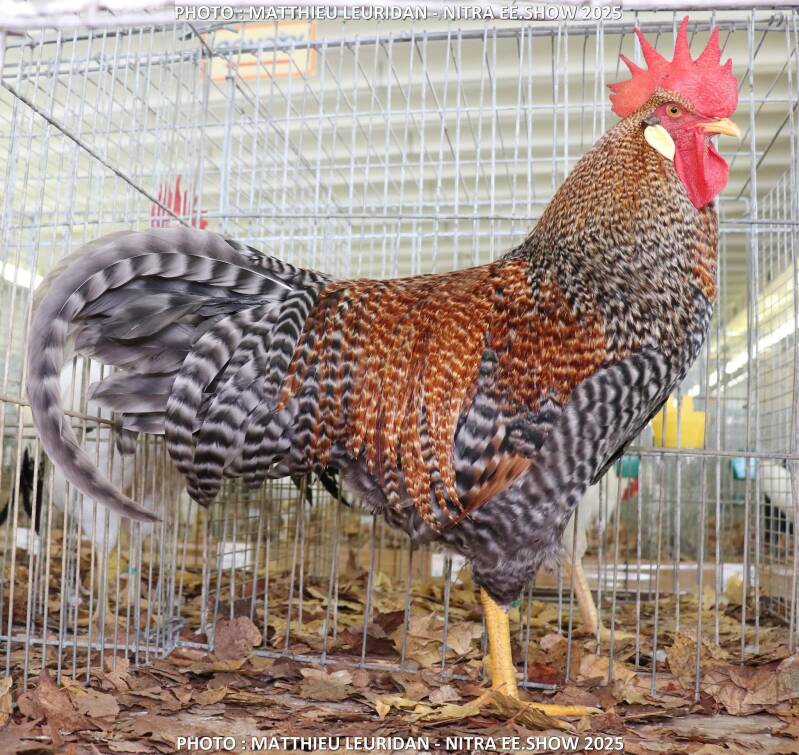
Color and pattern of the male
Plumage: basicly similar to goldpartridge, but all black, orange, carmine and brown feather-areas are regularly crosswise patterned by V-shaped, less sharply defined, lighter-colored barring.
Neck- and saddle-hackle: each feather with a barred shaft-stripe, the sharpness of the pattern and intensity are not high requirements, the shaft-stripe runs parallel to the feather-outline, ends in a point near the tip.; the saddle-hackle has more or less distinct shaft-stripe pattern, lack of pattern is not considered a fault.
Back, shoulder-arch and wing-triangle: some cuckoo-pattern can be observed.
The barred pattern can be present in both pure-bred and impure-bred males, which are allowed:
> Pure-bred male: the lighter barring is bright greyish-white and clearly wider than the dark-grey barring; the overall appearance is light.
> Impure-bred male: the lighter barrimg is greyish-white and clearly narrower than the dark-grey barring; the overall appearance is similar to the female.
Serious faults
>Pure-bred male: sickles and/or steering-feathers mostly white; complete off-color feathers.
> Impure-bred male: white in the tail and/or wings; too few cuckoo pattern in the wings, tail and breast; complete off-color feathers;
In addition, for both males: excessive brown in the breast, belly and thighs; straw-colored in the lower part of the neck-hackle.
Faults
The above serious faults are less common. Too light ground-color on the neck. Incomplete colored wing-triangle.
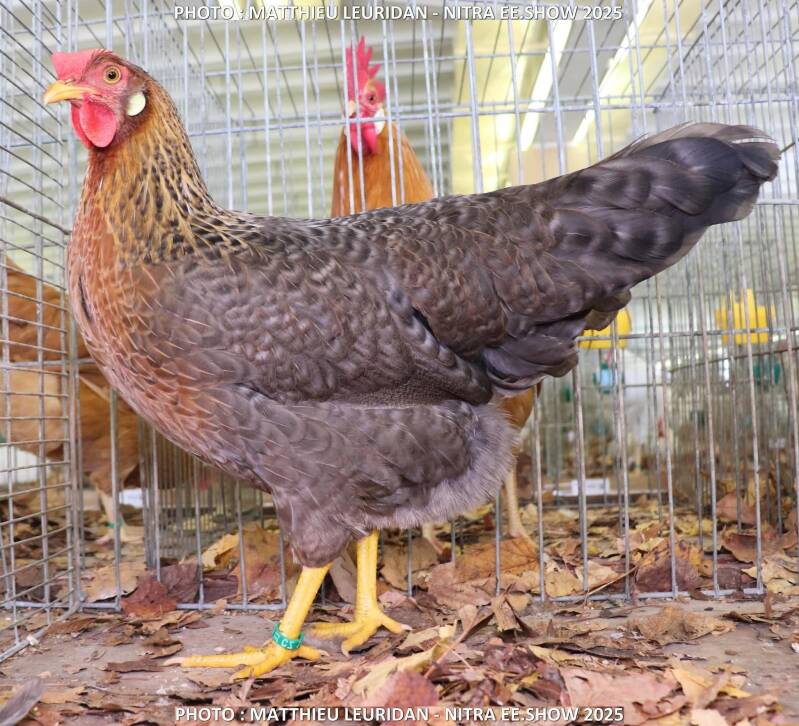
Color and pattern of the female
Plumage: basicly similar to goldpartridge, but all black, orange, carmine and brown feather-areas are regularly crosswise patterned by V-shaped, less sharply defined, lighter-colored barring.
Neck: each hackle feather with a barred shaft-stripe; the sharpness of the pattern and the intensity are not high requirements; the shaft-stripe runs parallel to the feather-contour, ends in a point near the tip.
Back, wing-coverts, saddle and tail-coverts: grayish-brown with black peppering, interrupted several times transversely by barring that is lighter than the ground-color and do not show peppering in those areas.
Primary-flights: blackish-brown and interspersed transversely with slightly lighter barring, smooth transition between lighter and darker barring.
Secondary-flights: outer-vane brownish-grey with black peppering, interspersed several times transversely with lighter clouding and showing no peppering in any area, the lighter and darker barring merge smoothly into each other; inner-vane blackish-brown and interspersed transversely with slightly lighter barring, smooth transition between lighter and darker barring.
Tail: steering-feathers blackish-brown and transversely interrupted with slightly lighter barring, smooth transition between lighter and darker barring.
Breast: as evenly salmon-colored as possible.
Serious faults
Complete lack of cuckoo pattern on the neck-hackle. Lack of peppering on the shoulders. Too light veining. Very coarse or clumped peppering. Prominent cuckoo-pattern on the breast. Too pale breast-color. Too little cuckoo-pattern on the tail and wings. Excessively contrasting cuckoo-pattern on the back, shoulder-arch, wing-coverts, saddle and tail-coverts. Complete white feathers in wing-flights young chickens.
Faults
The above serious faults occur less frequently. Too light ground-color on the neck-hackle.
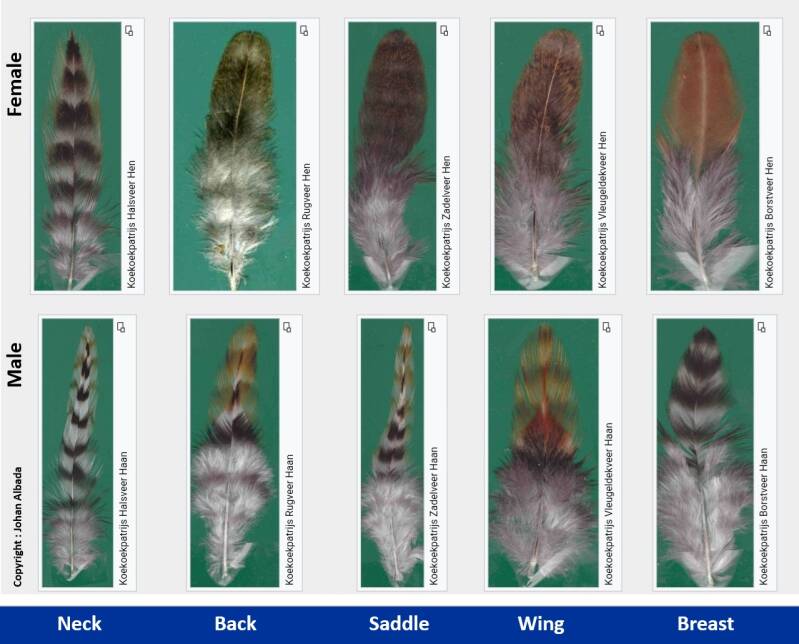
Feather details from: http://www.kippenencyclopedie.nl
Website from Johan Albada with more than
5000 photos of chickens, chicken color varieties and feathers.
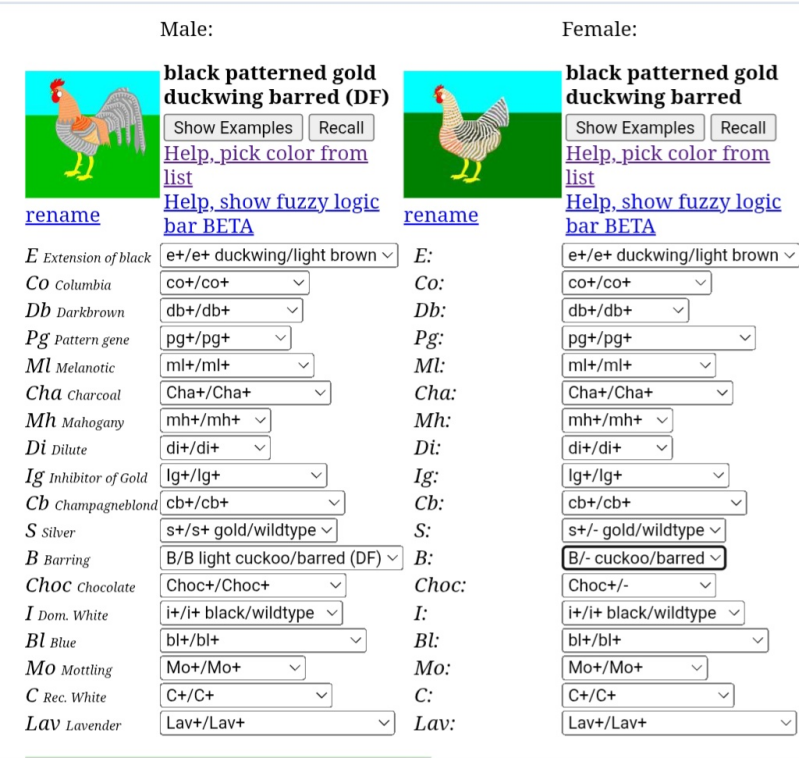
Genetic code: https://kippenjungle.nl/Overzicht.htm
Website from Henk Meijers with all available information regarding
chicken genetics including the world famous
Chicken Color Calculator
Create Your Own Website With JouwWeb