Laced goldpartridge
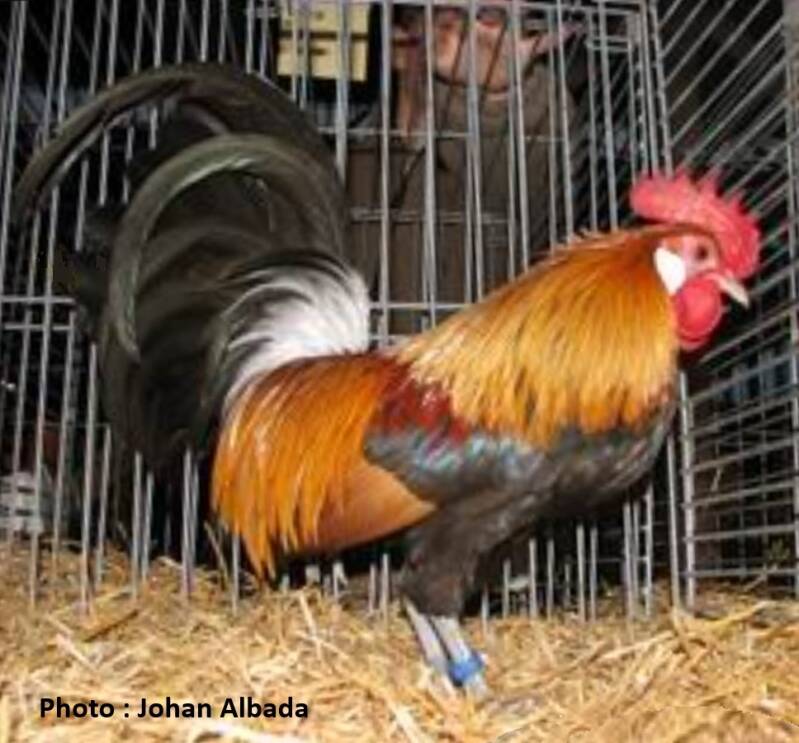
Color and pattern male
Head: orange-red.
Neck: hackle warm orangey golden-yellow, each feather with a glossy black shaft-stripe running almost parallel to the edge, ends in a point near the tip; front of the neck similar to the breast.
Back and saddle: back carmine red; hackle warm orangey golden-yellow, each feather with a green-glossy black shaft-stripe running almost parallel to the edge, causing each feather to appear laced with warm orangey golden-yellow; a slightly deeper shade than in the neck-hackle is permitted, as much uniformity as possible is desirable.
Tail: steering-feathers black; sickles, by-sickles and coverts green-glossy black, coverts laced with warm orangey golden-yellow.
Wings: bow black, shoulder-arch carmine-red, wing-bar green-glossy black.
Primary-flights: black with deep reddish-brown along the outer-edge of the outer-vane.
Secondary-flights: black with deep reddish-brown lace along the outer-edge of the outer-vane, forming a red-brown wing-triangle when the wing is closed.
Breast: glossy black, the majority of the feathers must have a yellow-brown tip or lacing that extends no further than halfway.
Flanks and thighs: black, feathers mostly with a yellow-brown tip or lacing that extends no further than halfway.
Belly and rear-part: black.
Down: grayish.
Serious faults
White in sickles and tail. Grey in wing-flights. Too light color in neck- and saddle-hackle. Entirely black breast.
Faults
The above serious faults occur to a lesser extent. Wing-triangle too light and incomplete colored. Shaft-stripe too faint.
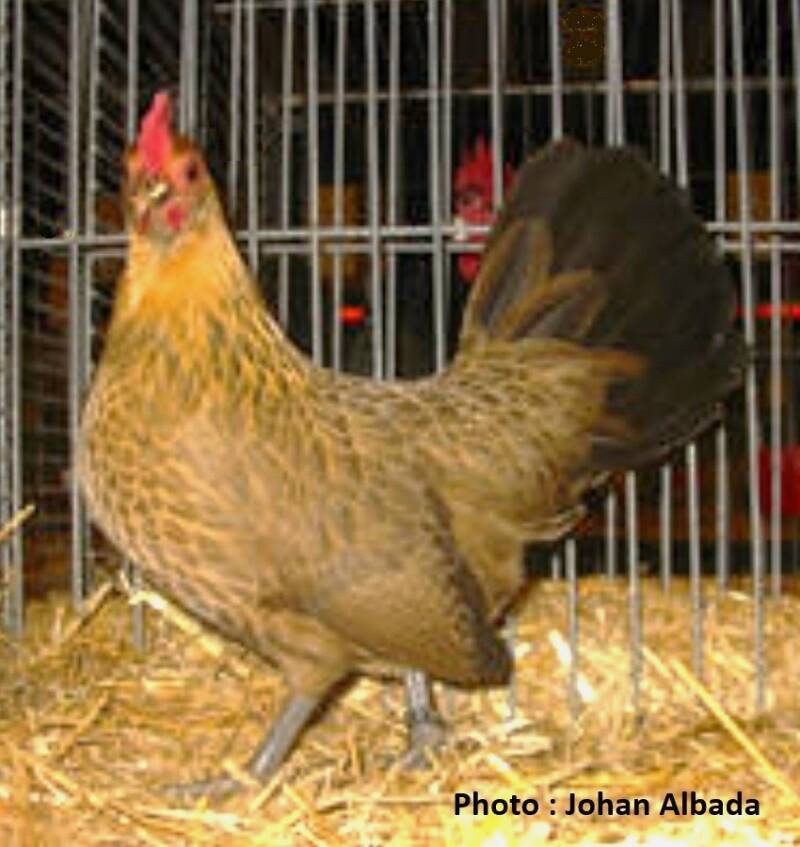
Color and pattern female
Explanation
Laced goldpartridge differs in females from the so-called "Asiatic" lacing because the ground-color is abundantly present. Consequently, in the otherwise clearly patterned feathers, the dull black irregularly serrated pattern between the laces is very narrow. Furthermore, all feathers have a bright, glossy golden-yellow, not too narrow outer-lace without any black. The outer-lace is clearly present on all feathers. In older females this lace is dull.
Head: deep yellow-brownish orange.
Neck: hackle orange-gold, each feather with a black shaft-stripe containing some orange-brown pattern, running parallel to the feather-edge, it ends in a point close to the tip; front of the neck similar to the upper-breast.
Back: warm yellow-brown ground-color; parallel to the feather-edge runs a dull-black to greyish tempered narrow serrated pattern ; ground-color is richly present; feathers show more serration towards the shoulders; the golden-yellow outer-lace is entirely free of black and possesses a strong sheen; the ground-color should not be too abundant, provided the feathers are clearly patterned; the back- and saddle feathers therefore do not need to have the serrated pattern; a even peppering within the distinct outer-lace is also permitted, though serration is preferred.
Wings: coverts warm greyish brown-yellow, the serrated pattern running parallel to each other and to the feather-outline.
Primary-flights: dull black with greyish-brown edge on the outer-vane.
Secondary-flights: feathers inner-vane black, outer-vane greyish-brown with dull-black, serrated pattern running approximately parallel to the feather-outline.
Tail: tail feathers black, the upper feathers black with warm greyish-brown marking, tail coverts warm greyish-yellowish-brown with serrated pattern, parallel to each other and to the feather outline.
Breast: warm grayish yellow-brown, each feather with two or more distinct edges of warm grayish yellow-brown, separated by a very narrow dull black serrated pattern, parallel to each other and to the feather outline.
The black is dull to grayish tempered.
The base color may break through the dull black serrated pattern, provided the pattern remains distinct. The yellow-brown base color of the outer edge is entirely free of black and possesses a strong sheen in young animals. Belly and hindquarters: belly and flanks have a less sharp pattern that transitions towards the rear into solid grayish yellow-brown. Thighs: less sharply marked than the breast.
Down: grayish.
Serious faults
White in tail; mottling in wing feathers; serrated pattern too broad and too straight where required; absence of the outer edge; serrated pattern not parallel to the feather edge; rust on back and wings; base colour too red or straw yellow; white in edging; red or salmon colour on breast.
Faults
Above serious faults present to a lesser degree; vein pattern too broad and light on the breast; clumped peppering on back, saddle and on small flight feathers.
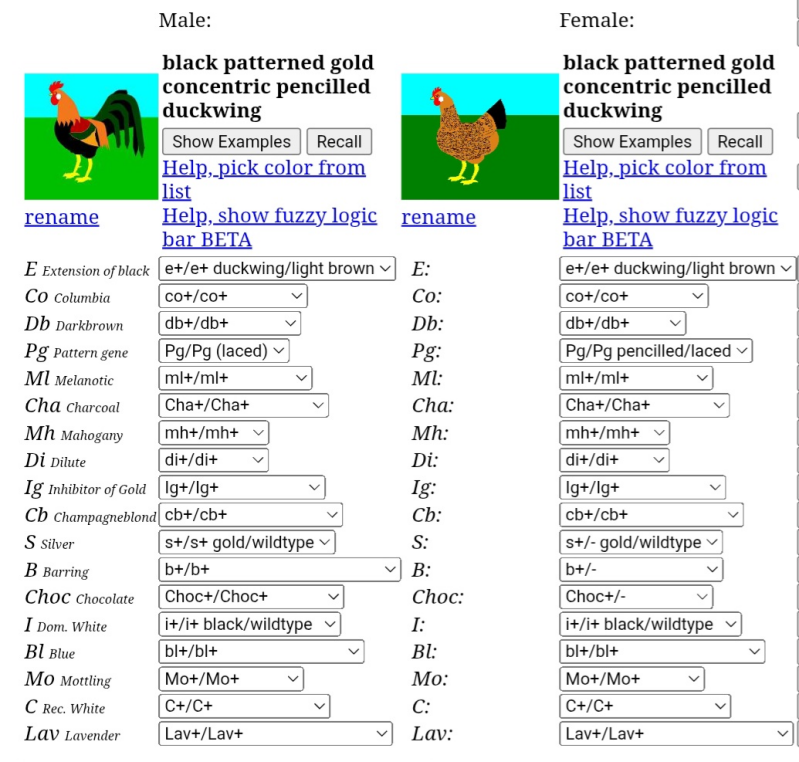
Genetic code: https://kippenjungle.nl/Overzicht.htm
Website from Henk Meijers with all available information regarding
chicken genetics including the world famous
Chicken Color Calculator
Create Your Own Website With JouwWeb