Blue-partridge
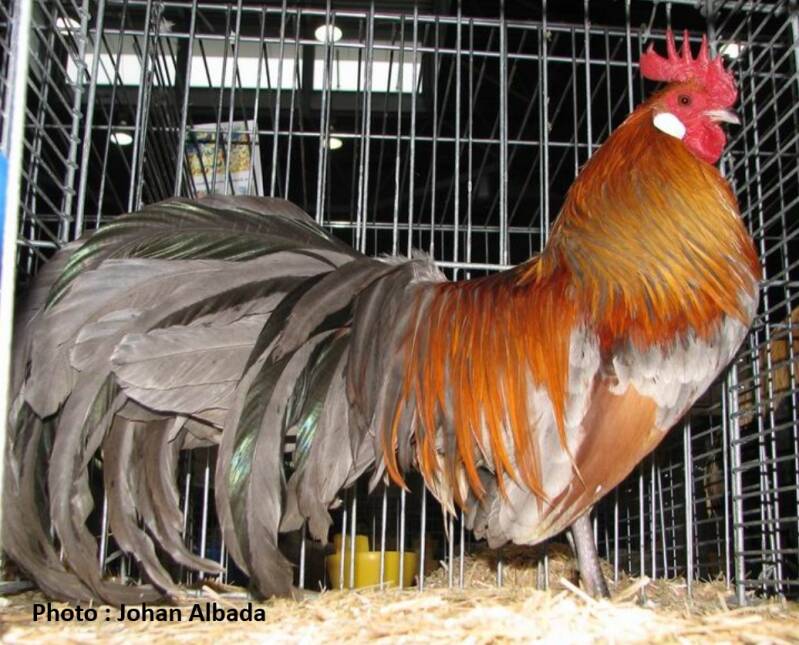
Color and pattern of the male
Head: light orange-red.
Neck: hackle from top to bottom changing from orange to orange-yellow; each feather with a bright-blue shaft-stripe, runs parallel to the outline, ends in a point near the tip, no high demands on the sharpness and the intensity; front of the neck bright-blue.
Back, shoulders and wing-bows: light carmine red.
Saddle-hackle: orange to ligh-orange each feather with more or less distinct blue shaft-stripe, absence is not considered a fault; a slightly deeper tint than in the neck-hackle is allowed.
Tail: main-feathers, sickles and coverts bright-blue.
Wings: front and wing-bar bright-blue.
Primary-flights: bright-blue with a narrow brown edge along the outer-web.
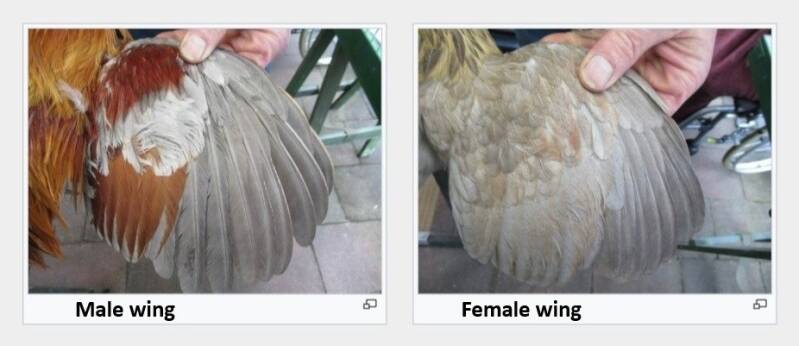
Secondary-flights: inner-web bright-blue, outer-web brown, forming a brown wing-bay when the wing is closed.
Breast: bright-blue.
Belly, thighs and fluff: bright-blue.
Down: greyish.
Serious faults
White in sickles, tail and wing-flights. Much brown in the breast, belly and thighs. Straw-yellow in the lower part of the hackles. Rusty blue. Much too dark-blue.
Faults
Minor deviations in color and pattern. Some unevenness and slightly too dark in the tail. Incompletely colored wing-triangle. Absence of the shaft-stripes in the neck-hackle.
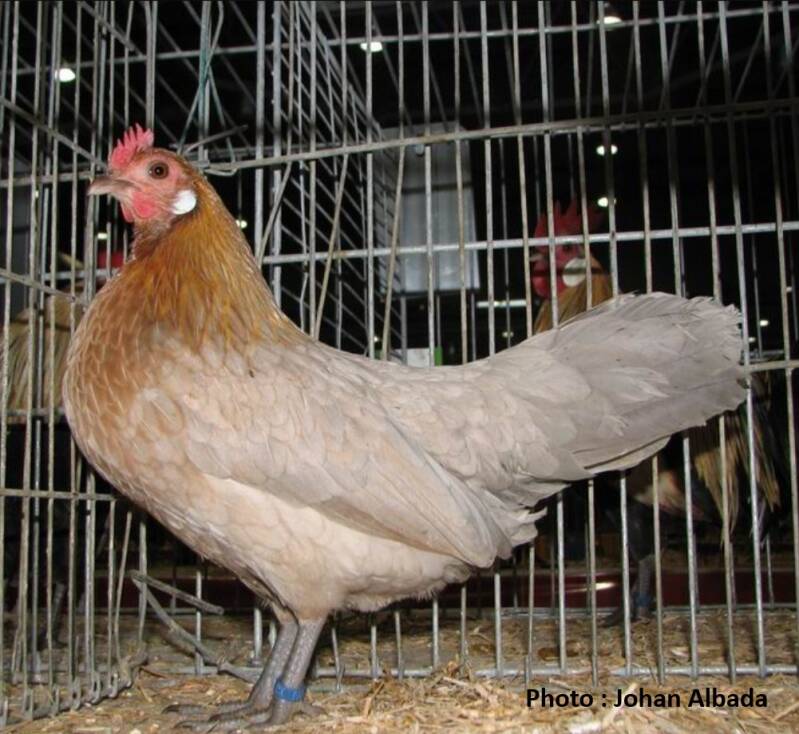
Color and pattern of the female
Head: golden-yellow.
Neck: hackle golden-yellow, each feather with a black shaft-stripe, runs parallel to the outline, ends in a point near the tip, no high demands on the sharpness and the intensity; front of the neck similar to the breast.
Back, shoulders, wing-coverts and saddle: each feather golden grey-brown with fine evenly distributed bright-blue peppering; as few light-colored veins as possible; slightly light lacing allowed but not desired.
Primary-flights: bright blue-brown with a narrow grey-brown edge along the outer-web.
Secondary-flights: outer-web similar to the back; inner-web bright blue-brown.
Tail: bright-blue main-feathers except for the upper ones, which like the coverts are golden-brown with fine bright-blue peppering.
Breast: salmon light reddish-brown transitioning to ash-brown at the thighs, veins salmon.
Belly, thighs and fluff: ash-brown.
Down: greyish.
Serious faults
Rusty on wings. Brown sheen on back, saddle-cushion and wing-coverts. Light veins. Yellowish tint in the neck-hackle. Complete absence of shaft-stripes. Much too dark-blue.
Faults
Minor deviations in color and pattern. Slightly clumped peppering and light veins on the breast.
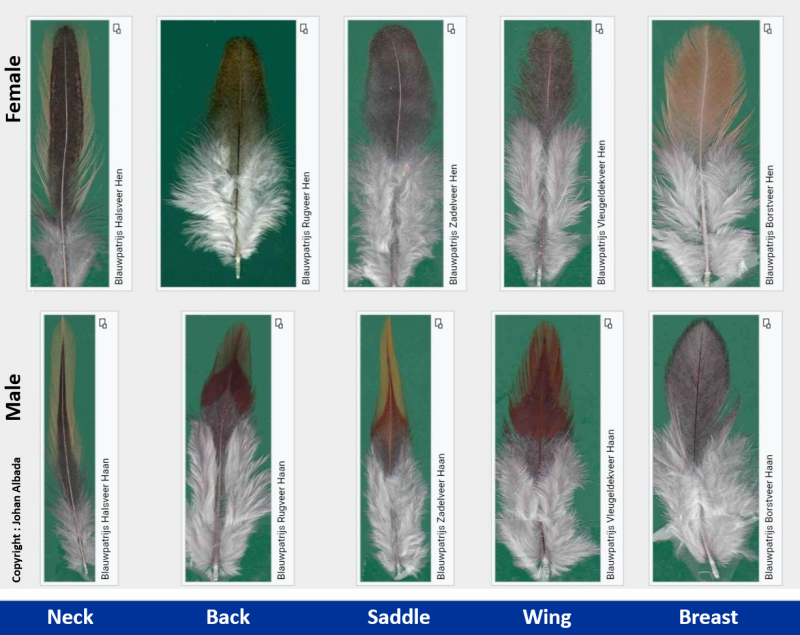
Feather details from: http://www.kippenencyclopedie.nl
Website from Johan Albada with more than
5000 photos of chicken-breeds, chicken color varieties and feathers.
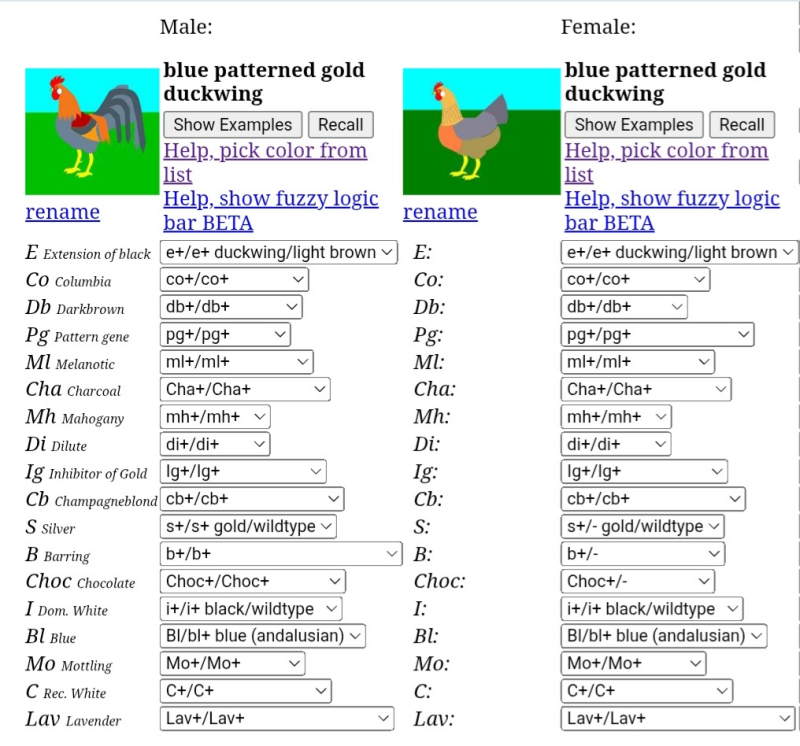
Genetic code: https://kippenjungle.nl/Overzicht.htm
Website from Henk Meijers with all available information regarding chicken genetics including the world famous
Chicken Color Calculator
Create Your Own Website With JouwWeb