Laced silver-partridge
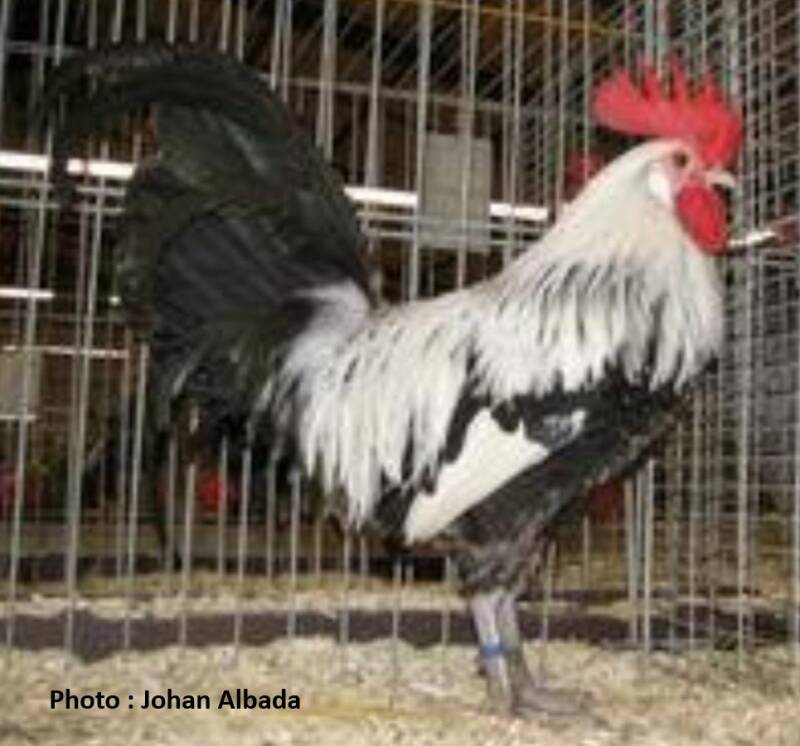
Color and pattern male
Head: silver-white.
Neck: hackle silver-white, each feather with a glossy green-black middle-stripe running almost parallel to the edge, ending in a point near the end; front of the neck similar to the breast.
Back, shoulders and wing-bows: silver-white.
Saddle-hackle: silver-white, each feather with a green-glossy black middle-stripe running almost parallel to the edge, causing each feather to appear laced with silver-white.
Tail: main-feathers black; sickles and coverts glossy green-black, coverts laced with silver-white.
Wings: front black, wing-bar green-glossy black.
Primary-flights: black with white along the outer-web.
Secondary-flights: black with a white lace on the outer-web forming a white wing-bay when the wing is closed.
Breast: glossy green-black, the majority of the feathers must have a white tip or lacing that extends no further than halfway.
Flanks and thighs: black, feathers mostly with a white tip or lacing that extends no further than halfway.
Belly and fluff: black.
Down: greyish.
Serious faults
Yellow tint in the hackles. Middle-stripes too faint. White in tail. Rust-brown or red on shoulders and wing-bows. Entirely black breast.
Faults
Serious faults to a lesser degree. Wing-bay incomplete colored.
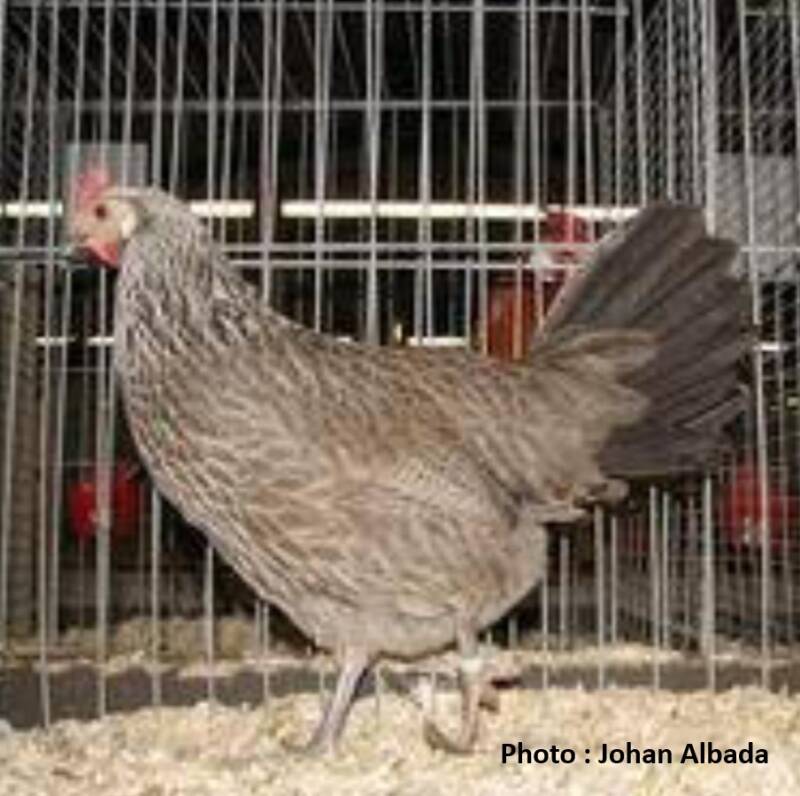
Color and pattern female
Explanation: Laced partridge differs in females from the so-called "Asiatic" lacing because the ground-color is abundantly present. Consequently, in the otherwise clearly patterned feathers, the dull black to greyish tempered narrow irregularly serrated-pattern between the laces is very narrow. Furthermore, all feathers have a bright silver-white, not too narrow, outer-lace without any black. The outer-lace is clearly present on all feathers, in older females the lace is dull.
Head: silver-grey.
Neck: hackle silver-grey, each feather with a black middle-stripe containing some white pattern, running parallel to the edge, ending in a point near the end; front of the neck similar to the breast.
Back, shoulders and saddle: silver-grey; parallel to the feather-edge runs a dull-black to greyish tempered narrow serrated-pattern, showing more serration towards the shoulders; the ground-color cannot be too intense, provided the feathers are clearly patterned; back- and saddle-feathers do not need to have the serrated-pattern, a even peppering within the distinct outer-lace is also permitted, though serration is preferred.
Wings: coverts silver-grey, parallel to the feather-edge runs a dull-black to greyish tempered narrow serrated-pattern, outer-lace glossy silver-grey
Primary-flights: dull black with silver-grey along the outer-web.
Secondary-flights: inner-web black, outer-web silver-grey with dull-black serrated-pattern running approximately parallel to the feather-edge.
Tail: main-feathers black, the upper ones black with silver-grey pattern; coverts similar to the back.
Breast: similar to the wing-coverts, the ground-color may break through the serrated-pattern, as long as the pattern remains distinct.
Thighs, belly and fluff: similar to the breast, less sharply patterned and towards the fluff shading into greyish.
Down: greyish.
Serious faults
Yellowish tint in the neck-hackle. Excessive ground-color in the middle-stripes. White in tail. Serrated pattern too broad and too straight where required. Light-coloured shafts. Lack of or too indistinctly patterned outer-lace. Very irregular pattern. Rust on back, shoulders and wings. Ground-color too red or straw-yellow. Red or salmon color on breast.
Faults
Serious faults to a lesser degree. Some ground-color in the middle-stripes. Too broad and light shafts on the breast. Clumped peppering on back, shoulders, saddle, tail-coverts and secondary-flights.
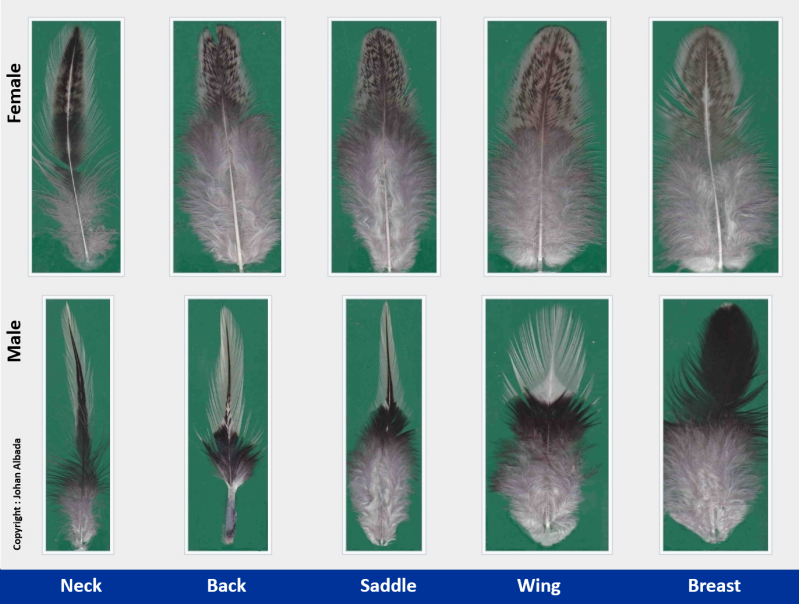
Feather details from: http://www.kippenencyclopedie.nl
Website from Johan Albada with more than
5000 photos of chicken-breeds, chicken color varieties and feathers.
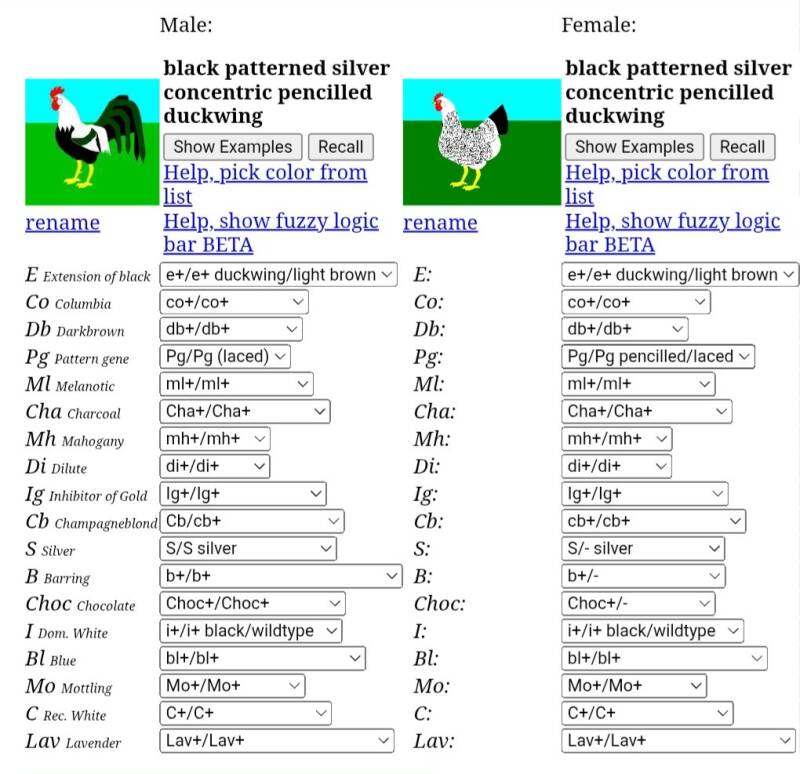
Genetic code: https://kippenjungle.nl/Overzicht.htm
Website from Henk Meijers with all available information regarding chicken genetics including the world famous
Chicken Color Calculator
Create Your Own Website With JouwWeb