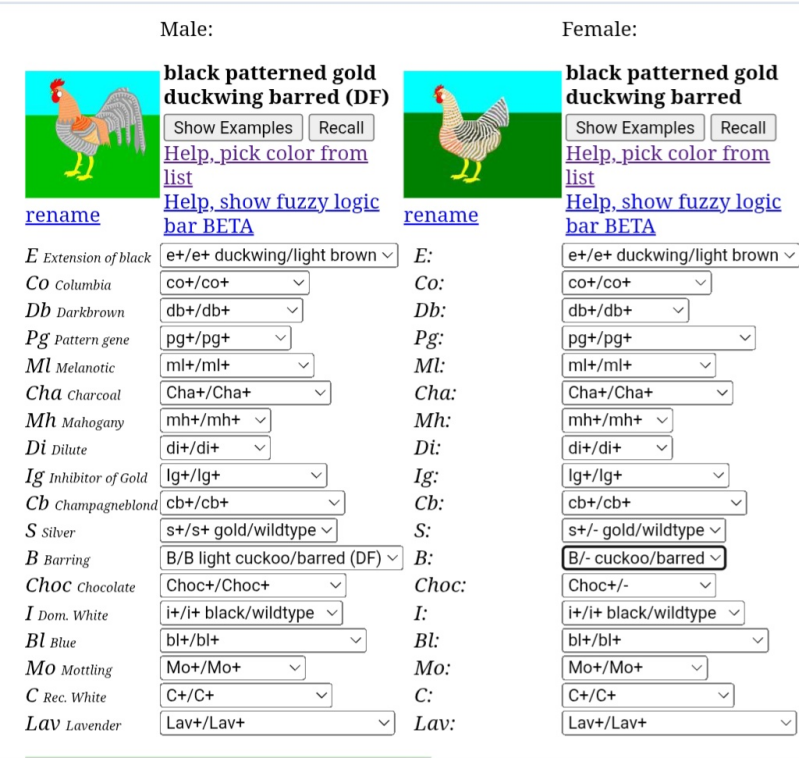
Cuckoo gold-partridge
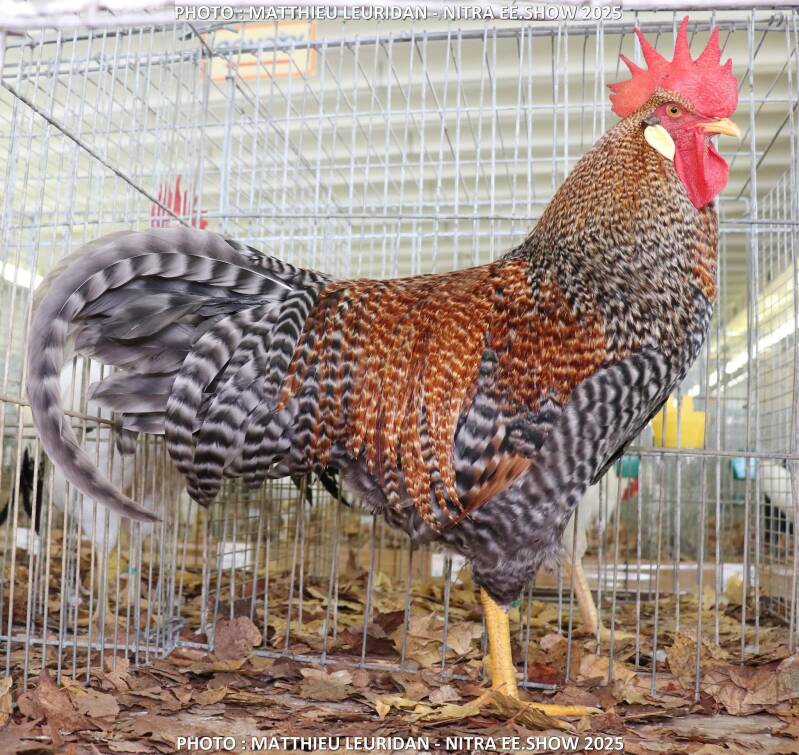
Color and pattern male
Plumage: basicly similar to gold-partridge; feathers with cuckoo pattern, each one dark-grey, three or four times crosswise interrupted by a light-grey slightly arched bar which is not sharply defined; in ornamental feathers the number of crosswise bars is larger in proportion to the length, the bars tends towards an inverted V; males are allowed in either purebred or impurebred where the difference is that the appearance of the purebred is clearly lighter than the female an the impurebred is similar to the female.
Head: orange-red.
Neck and saddle: hackle orange, each feather with a cuckoo pattern middle-stripe, no high demands on the sharpness and the intensity; front of the neck similar to the breast; saddle-hackle has more or less distinct middle-stripe, absence is not considered a fault.
Back, shoulders and wing-bows: carmine-red, some cuckoo pattern visible.
Wings: front and wing-bar cuckoo pattern.
Primary-flights: cuckoo pattern with a narrow brown edge on outer-web.
Secondary-flights: inner-web cuckoo pattern, outer-web brown, forming a brown wing-bay when the wing is closed.
Tail and breast: cuckoo pattern.
Thighs, belly and fluff: grey.
Down: grey.
Serious faults
Complete off-color feathers. White in tail and wing-flights. Excessive brown in the breast, thighs and belly. Straw-yellow in the lower part of the neck-hackle. Too little cuckoo pattern in wings, tail and breast of impurebred.
Faults
Serious faults to a lesser degree. Incomplete colored wing-bay. Insufficient contrast between the light- and dark-grey bars in tail and wing-flights. Entire black feathers.
Color and pattern female
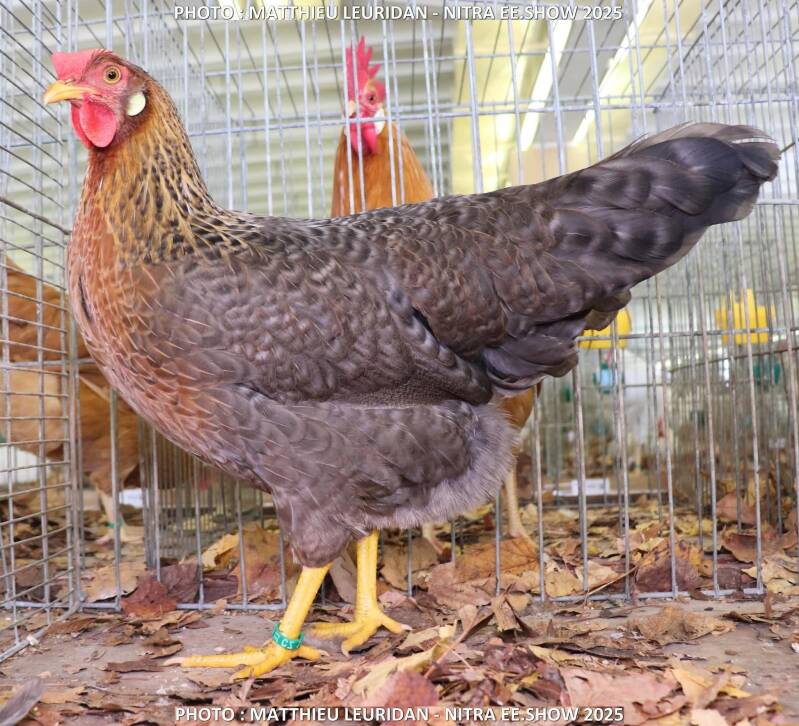
Plumage: basicly similar to gold-partridge, feathers with cuckoo pattern, each one dark-grey, three or four times crosswise interrupted by a light-grey slightly arched bar which is not sharply defined.
Head: golden-yellow.
Neck: hackle golden-yellow, each feather with a cuckoo pattern middle-stripe, no high demands on the sharpness and the intensity; front of the neck similar to the breast.
Back, shoulders, wing-coverts, tail-coverts and saddle: each feather light greyish-brown with black peppering and cuckoo pattern without peppering in the light-grey bars.
Primary-flights: blackish-brown crosswise interrupted by a slightly lighter bar, smooth transition between dark and light bars.
Secondary-flights: outer-web brownish-grey with black peppering, crosswise interrupted by a slightly lighter barring without peppering, smooth transition between dark and light bars; inner-web blackish-brown crosswise interrupted by a slightly lighter bars, smooth transition between dark and light bars.
Tail: main-feathers blackish-brown and crosswise interrupted with slightly lighter bars, smooth transition between dark and light bars.
Breast: as even salmon as possible.
Thighs, belly and fluff: ash-silver
Down: greyish.
Serious faults
Complete lack of cuckoo pattern on the neck-hackle. Lack of peppering on the shoulders. Shafts too light. Very coarse or clumped peppering. Cuckoo pattern with to much contrast on back, shoulders, wing-coverts, tail-coverts and saddle. Prominent cuckoo-pattern on the breast. Too pale breast-color. Too little cuckoo-pattern on the tail and wings. White on wing-flights.
Faults
Serious faults to a lesser degree. Too light ground-color on the neck-hackle.
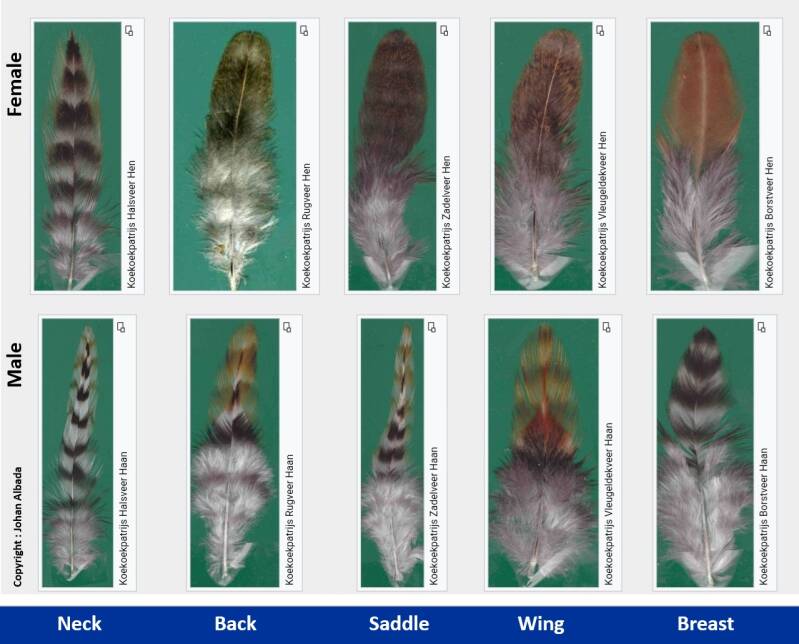
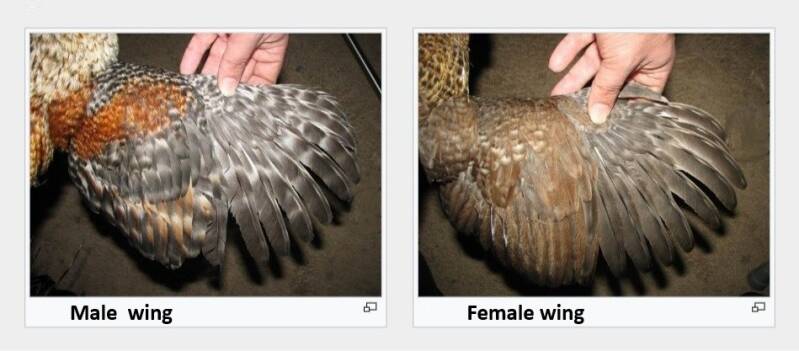
Feather details from: http://www.kippenencyclopedie.nl
Website from Johan Albada with more than
5000 photos of chickens, chicken color varieties and feathers.
Genetic code: https://kippenjungle.nl/Overzicht.htm
Website from Henk Meijers with all available information regarding chicken genetics including the world famous
Chicken Color Calculator
Create Your Own Website With JouwWeb