Red millefleur
Note
As the chickens with the mottled color varieties age, the amount of white in the pattern will increase. Two-year-old chickens generally have the best pattern distribution.
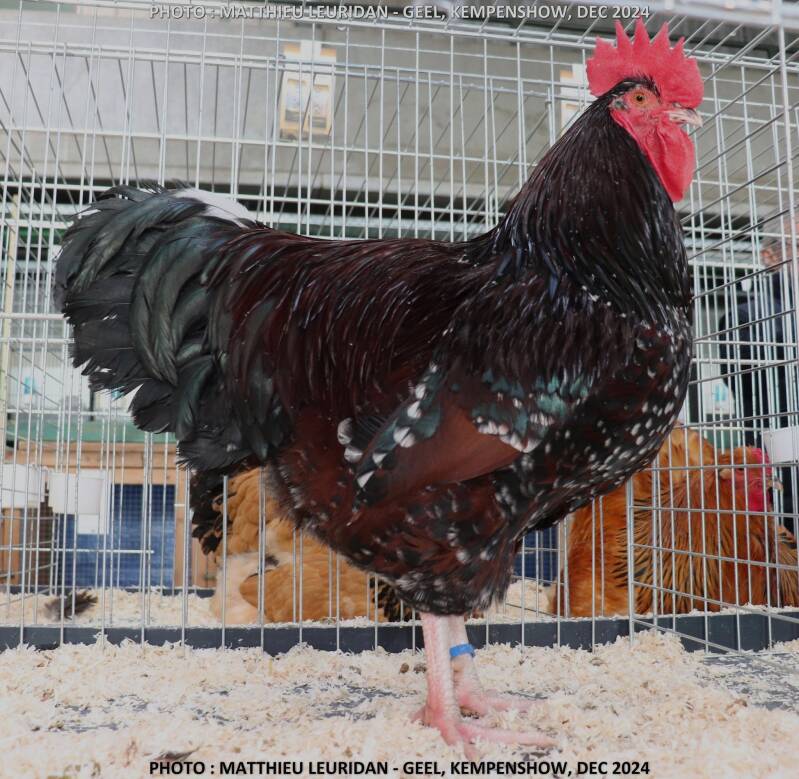
Color and pattern of the male
Head: dark, warm brown-red.
Neck: hackle warm brown-red; each feather with a green-glossy black shaft stripe which becomes narrower and ends near the tip, at the tip a tiny diamond-shaped white mottle, at the inner tip connecting to the tip of the fairly short and tiny, diamond-shaped green-glossy black spot, on the sides of the feather a brown-red ornamental fringe; front of the neck similar to the breast.
Back: dark, reddish-warm brown-red , each feather with a diamond-shaped, green-glossy black spangle and a small white spot at the feather tip.
Saddle: hackle similar to the neck-hackle, the green-glossy black shaft stripe pattern as well as the white tip at the end of each feather, are less noticeable than in the neck-hackle, because the feathers of the saddle-hackle ends thinner than those of the neck-hackle.
Tail: steering-feathers black, each feather with a white mottle at the end; sickles and coverts green-glossy black with a small white V-shaped mottle at the end.
Wings: bow feathers almost black; shoulder feathers reddish brwn-red, sparsely with tiny white mottled tips; greater-coverts warm brown-red each feather ending in a large, almost round, glossy green black spangle with a V-shaped white mottle, which forms a clear black and white wing-bar across the wing.
Primary-flights: inner vane black, outer vane black with a narrow brown-red lace, the lower end white-mottled.
Secondary-flights: outer vane warm brown-red, inner vane dull black laced feather-end, which is white-mottled.
Breast: warm brown-red, each feather ends in a large, almost round, green-glossy black spangle with a V-shaped white mottle.
Belly and thighs: approximately similar to the breast.
Down: blue-grey with a salmon-colored tinge, fading to light gray at the base.
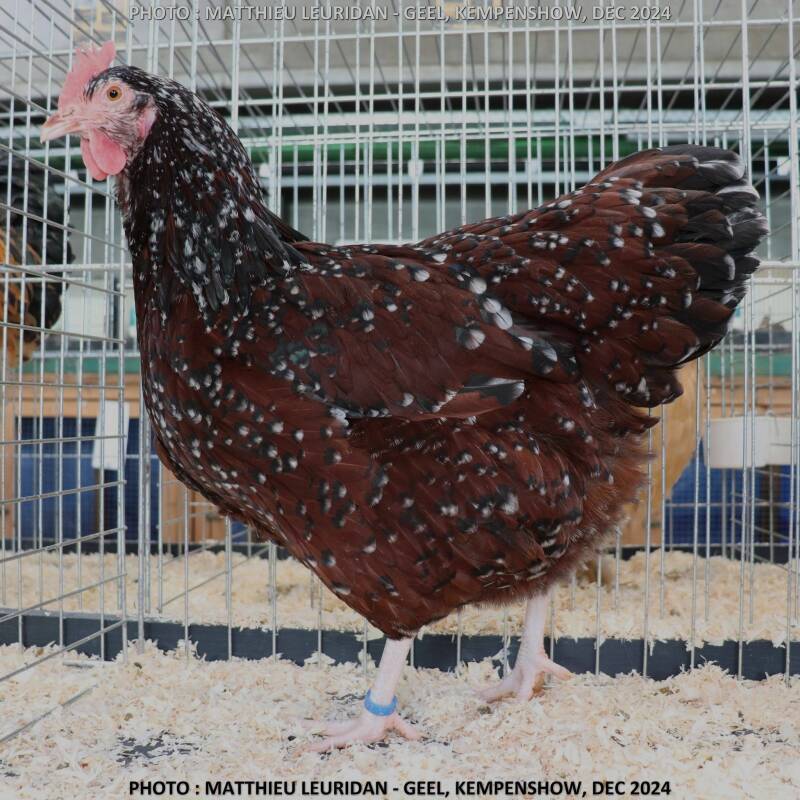
Color and pattern of the female
Head and neck: warm brownish-red , each with a green-glossy black shaft stripe ends in a green-glossy black spangle with a diamond-shaped pure white mottle; front of the neck similar to the breast.
Back and saddle-cushion: similar to the breast.
Tail: steering- feathers dull black, with a diamond-shaped pure white mottle; coverts similar to the breast; the upper-covert on each side is covered by a strongly extended covert, which is, except for the slightly longer black spangle, similar to the other coverts.
Wings: bow, shoulder and coverts warm brown-red, each feather ends in a large, almost round, green-glossy black spangle with a V-shaped white mottle.
Primary-flights: inner vane black, outer vane slightly brown-red laced, lower end of the feathers white laced.
Secondary-flights: outer vane warm brown to near the end of the feather, inner vane dull black to almost the end of the feather and then broadening to the outer vane, connecting to a white mottle at the end of the feather.
Breast: warm brown-red, each feather ends in a large, almost round, green-glossy black spangle with a V-shaped white mottle.
Belly, thighs and rear-end: similar to the breast.
Down: grey with a salmon-colored tinge, fading to light gray at the base.
Serious faults male and female
Considerably too light or too dark a shade of the warm brown-red ground-color. Considerably too light breast color. Too strong development of the black spangle pattern in the male's breast. Too little pattern in the breast feathers. Coarse white mottled pattern. Completely irregular diluted pattern. Too much white in the wing-flights.
Faults male and female
Slightly different shade from the prescribed ground color. Slightly too much white in over-aged and older chickens. Slightly too much white in the wing-flights.
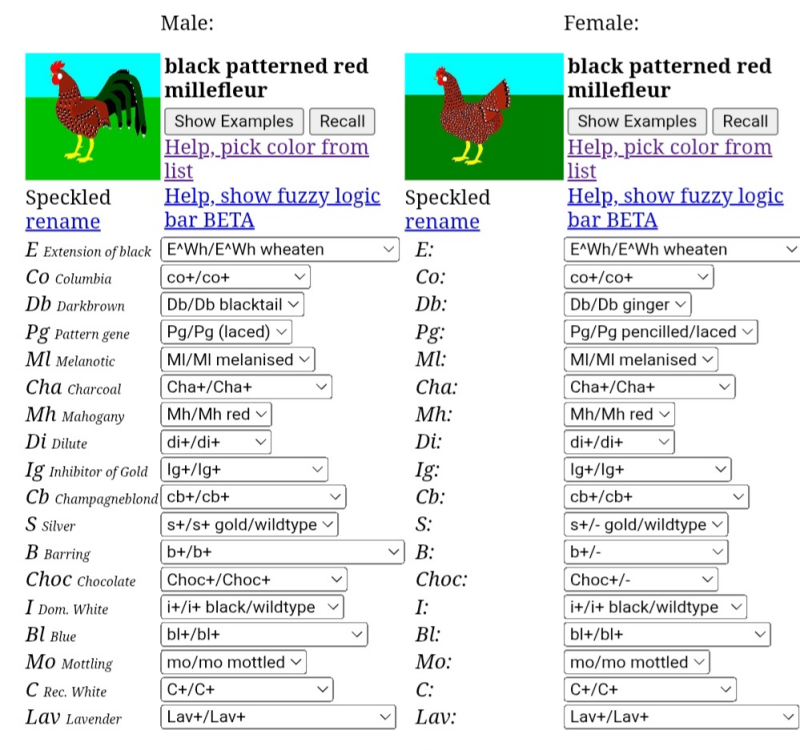
Genetic code: https://kippenjungle.nl/Overzicht.htm
Website with all available information regarding chicken genetics including the chicken color calculator.
Create Your Own Website With JouwWeb